To download the Op-ed, please click here
I was in Jakarta this week for an IMF-Bank Indonesia conference on “The Future of
Asian Finance”. This is also the title of a book launched last week, in which experts at
the International Monetary Fund provided useful analyses to help Asian policymakers
navigate the current turbulence.
This weekend, the G20 finance ministers and central bank governors are meeting in
Ankara, with the aims of strengthening global recovery, enhancing resilience and
buttressing sustainability. Unfortunately, we seem to be heading in the opposite
direction.
The IMF memo for the G20 meeting noted the slowdown in global growth for the first
half of this year, and said financial conditions for emerging market economies have
tightened and risks are tilting towards the downside.
Understandably, it is calling for strong policy action to raise growth and mitigate risks.
The problem is that the G20 members are likely to pull in different directions.
On September 15, we will mark the seventh anniversary of the failure of Lehman
Brothers, a landmark event that triggered efforts to prevent a global collapse, which
consequently set us up for the greatest financial bubble in recorded history. In the
first half of this year, almost every country witnessed record peaks in their stock
markets, bond markets and real estate prices. Given the fact that most countries are
still slowing or having modest recoveries, the bubble has been pumped up by the
activist monetary policy adopted by advanced economies known as “quantitative
easing”.
Indeed, the McKinsey Global Institute has warned that global credit and leverage is at
its highest ever, and despite much soul-searching about the need for macro
prudential regulation to prevent bubble risks, there has not been much deleveraging.
We have the odd situation whereby the governor of the Bank of England, currently
chairman of the Financial Stability Board, warns about real estate bubbles, but hasn’t
dared so far to raise interest rates in his own country.
The US Federal Reserve is also anguishing over whether to raise interest rates this
month or in December. The polarity of the debate is astonishing. There are those
who say the US economy is now strong enough to take a 25-basis-point interest rate
increase, while authoritative figures like former Treasury secretary Larry Summers
have argued that another round of quantitative easing may be necessary to prevent
“secular stagnation”. When Chinese authorities intervened in the A-share market last
month, the Financial Times and The Wall Street Journal revelled in China’s debacle,
only to see their own markets – the Dow, Nikkei and German Dax – suffer the largest
drops since 2011 after the announcement of a renminbi devaluation of only 1.9 per
cent. People in glass houses should not throw stones at each other.
The markets are not wrong to be nervous. The current global turbulence is not the
fault of any single country, but the result of a highly fragmented international financial
system being buffeted without a single regulatory authority. We have moved from a
unipolar world to a multipolar casino where no one is fully in charge.
The system’s fragility stems from the fact that its inherent trade and debt imbalances
swing periodically to excesses without a coherent or single mechanism to control or
moderate them. Remember, the IMF is not the world’s central bank – that power was
assumed by the leading sovereign central banks, particularly the Fed.
In 2005, then chairman Ben Bernanke complained that the Fed was losing monetary
policy effectiveness because of excess savings by some countries, notably China
and Japan. Thus the US runs ever larger trade deficits, because the surplus
countries are more than willing to hold dollars in their foreign exchange reserves.
The 2007 financial crisis erupted when the trade imbalances generated a second-
order imbalance, when the US and European banks expanded credit both off their
balance sheets and offshore. The complacency of their regulators allowed these
banks to be excessively leveraged. Threats of raising interest rates then caused a
market reversal and illiquidity, leading to a crisis of confidence and collapse.
Seven years after the Lehman collapse, advanced economies’ central banks again
crow that they have “fixed” the problems, but the markets are as fragile as ever. They
are held together because the central banks have emerged as not only the lenders of
last resort, but also the buyers of first resort at any sign of market tantrums.
The stark reality is that it was China’s massive reflation in 2009 that reduced its
current account imbalances, increased commodity prices and pulled the world out of
recession. But that was at a cost of a huge internal credit binge. Now that China has
taken a pause in growth and attempted to correct its internal imbalances, the rest of
the world is taking fright.
When underlying imbalances are being corrected, there is no excess savings or
credit – only the prospect of higher interest rates. And higher interest rates mean the
pricking of the global asset bubble.
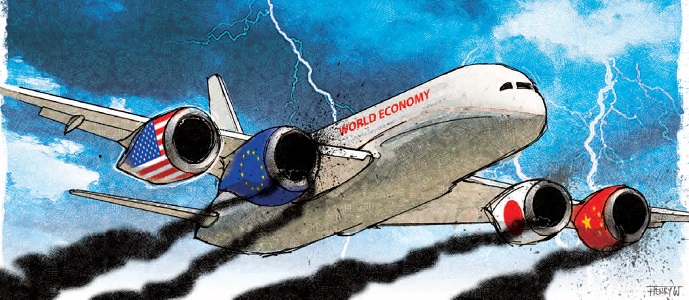
In short, before 2007, the world was a four-engine jet, propelled by the US, Europe,
Japan and the emerging markets, led by China. After 2009, when Europe and Japan
slowed, it was a two-engine jet, with China helping the US sustain growth and
currency stability. Since the US and Japan are hesitant to see China join the IMF’s
special drawing rights club, that second engine is being recalibrated.
The world is now flying on one engine, the US and US dollar. With a strong dollar
and growing fiscal and trade deficits, small wonder that the markets are debating
whether that engine is flying on empty.
Andrew Sheng comments on global issues from an Asian perspective.
This article first appeared in South China Morning Post, 4 September 2015
|
|